
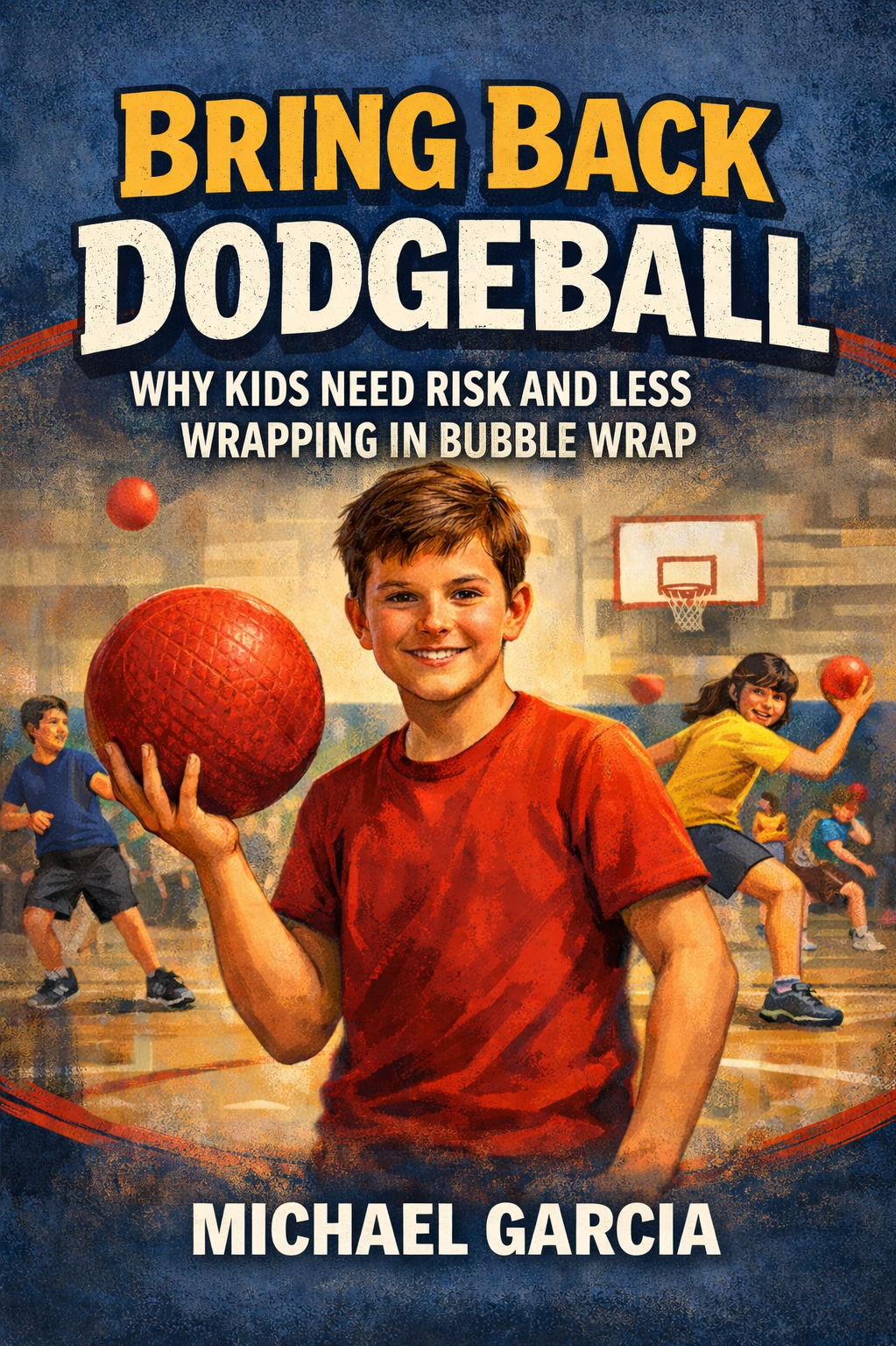
AI Generated Sample Book Cover
I’m currently in the early development stages of my next book, Bring Back Dodgeball: Why Kids Need Risk and Less Wrapping in Bubble Wrap, with a planned release in late 2027 / early 2028. As part of that process, I’m inviting a small group of thoughtful readers to help shape the work through an early review and feedback phase. I’m especially interested in hearing from youth professionals, educators, parents, caregivers, and anyone who thinks deeply about play, child development, and resilience. If you’re open to reading a short manifesto and offering honest perspective, including pushback or questions. I’d truly value your voice. If you’re interested in participating, please reach out via email, and I’ll share next steps.
Bring Back Dodgeball
Why Kids Need Risk and Less Wrapping in Bubble Wrap
We love our kids deeply. That’s not the problem.
The problem is that somewhere along the way, love gets confused with protection from everything. Discomfort started to look like danger. Struggle started to look like failure. And play… real play, messy play, unpredictable play, starts to feel like a risk that we weren’t sure we could afford.
So, we made childhood smoother. A little quieter. Safer on paper. And in doing so, we unintentionally took away some of the very experiences that teach kids how to handle life.
This isn’t about blame. This is about the current reality.
I see kids every day who are kind, filled with want and completely overwhelmed when something doesn’t go their way. When they lose, they melt down. When they fail, they freeze. When things get uncomfortable, they look for an adult to rescue them, not because they’re incapable, but because they’ve rarely been given the chance to work through it on their own.
That didn’t happen overnight. And it didn’t start with COVID. But COVID did accelerate it.
Kids lost critical time to practice being with other kids. Parents, especially those raising very young children in a world that suddenly felt more fragile, became understandably more anxious. Adults stayed closer. Intervened faster. Smoothed things over sooner. What began as protection slowly became the norm.
And now we’re seeing the impact.
This book isn’t asking us to go backward. It’s asking us to move forward with intention.
We are not trying to raise reckless kids. We are trying to raise capable ones.
A skinned knee is not a failure of supervision. It’s a lesson in awareness.
Losing a game is not trauma. It’s practice in recovery.
An argument on the playground is not a crisis. It’s a chance to learn empathy, communication, and repair.
Play is not a break from learning. Play is where learning becomes real.
Through play, kids learn how their bodies work. Through play, they discover their limits. Through play, they learn how to negotiate rules, manage frustration, take perspective, and try again after missing the mark.
When we remove all risk from play, we don’t make kids safer. We make them less prepared.
And preparation matters. Because one day, the stakes get higher. The failures get bigger. And there isn’t always someone standing close by to step in.
If kids don’t get the chance to fail safely now — to fall, to lose, to feel embarrassed, to recover — we set them up to struggle later, when the consequences are heavier and the safety nets are thinner.
This is not about toughening kids up. It’s about trusting them.
Trusting that they can climb. Trusting that they can miss. Trusting that they can navigate conflict. Trusting that, with steady adults nearby, they can learn how to get back up.
We don’t need to eliminate safety. We need to redefine it.
Safety is not the absence of risk. Safety is the presence of boundaries, supervision, intention, and space to grow.
Bring back dodgeball is not just the game, but what it represents. Bring back play that challenges bodies and emotions. Bring back the belief that kids are resilient and capable. Because we are not raising children for childhood alone. We are building future adults.
Adults who can handle disappointment. Adults who can navigate relationships. Adults who can fail, learn, and try again.
And play doesn’t just build those skills. It builds stories.
Stories kids tell about the game they lost and survived. Stories about the climb that felt scary until it wasn’t. Stories about missing the catch, laughing it off, and jumping back in. Stories about falling down, getting back up, and realizing they were okay.
Those stories matter.
They become part of how kids understand themselves. They learn, I can handle hard things. They learn, I can recover. They learn, I belong, even when I don’t win.
And yes; sometimes those stories come with a skinned knee. Sometimes with a scraped elbow. Maybe even a small scar. But scars don’t just mark where something went wrong. They mark where learning happened. If your child comes home with a scrape and a great story to tell, that’s not failure. That’s childhood doing exactly what it’s supposed to do.
Because long after the bandaids are gone, they’ll still have the story. And the confidence that comes with it.
Let them play. Let them struggle a little. Let them grow.